
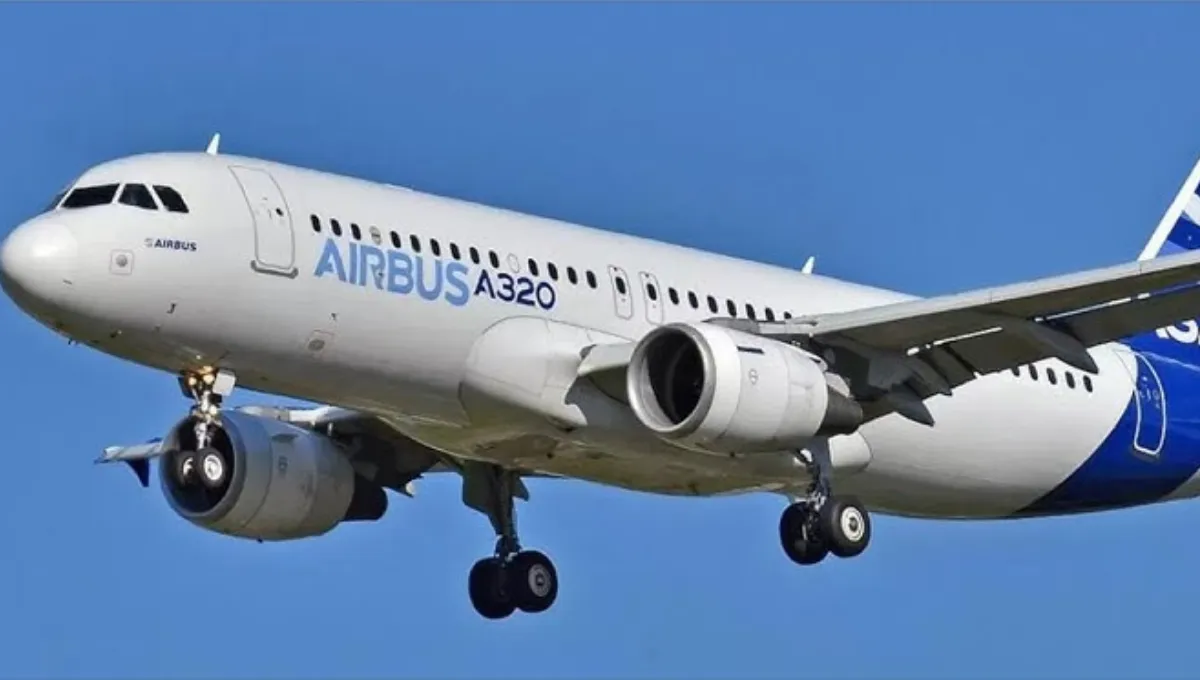
Washington (US News): Airlines and passengers breathed a collective sigh of relief on Monday as Airbus announced that the bulk of its massive fleet-wide recall had been resolved, just days after a bizarre software vulnerability linked to solar flares forced the grounding of around 6,000 A320-series aircraft and triggered widespread cancellations during the peak Thanksgiving travel crunch.
The crisis erupted late Friday when the European planemaker issued an unprecedented emergency directive, mandating immediate software downgrades or hardware swaps on more than half its global A320 fleet – the world’s most ubiquitous narrow-body jet, with over 11,300 in service carrying millions on short-haul routes each day. At the heart of the problem: intense bursts of solar radiation, like those from coronal mass ejections, that could scramble critical data in the aircraft’s Elevator and Aileron Computer (ELAC), the fly-by-wire brain governing pitch and roll stability. Without warning, this corruption might trigger uncommanded maneuvers, as seen in a harrowing mid-October scare aboard JetBlue Flight 1230 from Cancun, Mexico, to Newark, New Jersey.
Human Brain Develops in Five Distinct “Eras” Across a Lifetime, Major New Study Finds
That flight, on October 30, suddenly nosedived at cruising altitude, hurling passengers against their seatbelts and injuring several before the crew regained control and diverted to Tampa, Florida, for an emergency landing. No fatalities occurred, but the incident – coupled with fresh solar activity spiking radiation levels – prompted Airbus engineers to trace the fault to a specific software version vulnerable to cosmic interference. “Intense solar radiation may corrupt data critical to the functioning of flight controls,” the company warned in its bulletin, a rare admission that space weather could hijack modern avionics.
The recall’s scope was staggering, marking the largest in Airbus’s 55-year history and hitting just as the A320 family eclipsed Boeing’s 737 as the best-selling commercial jet ever delivered. In the U.S., where the Thanksgiving weekend funnels some 55 million travelers through airports, major carriers like American, Delta, JetBlue, and United – operators of hundreds of the affected models – faced a logistical gauntlet. The Federal Aviation Administration swiftly backed the European Union Aviation Safety Agency’s emergency airworthiness directive, grounding about 545 U.S.-registered A320s until fixed, with a hard deadline of midnight Sunday.
American Airlines, the globe’s biggest A320 user with over 1,400 in its stable, pulled 209 planes offline but confirmed by Saturday that every one had received the patch, minimizing ripple effects on its network. Delta reported under 50 impacts, while United echoed the quick turnaround, crediting round-the-clock technician teams. Overseas, the pain was sharper: Japan’s All Nippon Airways axed 65 flights on Saturday alone, India’s IndiGo and Air India warned of delays on 350 jets, and Australia’s Qantas – holding 65% of the domestic market alongside budget arms – saw rivals like Virgin unscathed but its own operations strained. Europe’s easyJet and Wizz Air completed overnight overhauls, restoring full schedules by dawn Saturday, while Air France scrapped 35 routes outright.
For most planes, the cure was straightforward: a two-to-three-hour software rollback to a hardened earlier iteration, uploaded via ground diagnostics without cracking open the fuselage. By midday Monday, Airbus reported the “vast majority” of the 6,000 jets compliant and airborne again, with under 100 still queued for final tweaks. “Airbus apologizes for any challenges and delays caused to passengers and airlines by this event,” the Toulouse-based firm said in a statement, highlighting partnerships that shaved hours off initial three-hour-per-plane estimates.
Lingering headaches persist for up to 15% of older models – around 900 aircraft – that may demand ELAC hardware swaps, potentially sidelining them for days or weeks as parts ship in. Analysts at Deutsche Bank pegged the broader hit as containable financially, though Airbus shares dipped 3% amid the frenzy, rebounding on news of the swift fixes. In the UK, Transport Secretary Heidi Alexander called the fallout “limited” for local carriers like British Airways, lauding the response as proof of aviation’s gold-standard safety protocols.
Aviation veterans like former Qantas captain Dr. Ian Getley, a PhD holder in cosmic radiation’s flight effects, framed the episode as a “very rare event” but a wake-up call on solar storms’ reach – plasma ejections from the sun that bombard high-flying jets with charged particles, far from the Hollywood trope of fiery solar flares. Redundant systems and pilot overrides, as on the JetBlue diversion, held firm, ensuring no crashes despite the digital hiccup. Still, the saga underscores a futuristic wrinkle in air travel: as planes grow smarter, they’re not immune to the sun’s whims.
With Christmas looming, regulators from the FAA to EASA vow vigilant oversight, and Airbus pledges ongoing solar-hardening research alongside ELAC maker Thales. For stragglers at gates from Delhi to Dallas, the message is clear – patience, as skies clear. Travelers dodged a bullet this time, but the stars aligned a reminder: even at 35,000 feet, the cosmos calls the shots.