
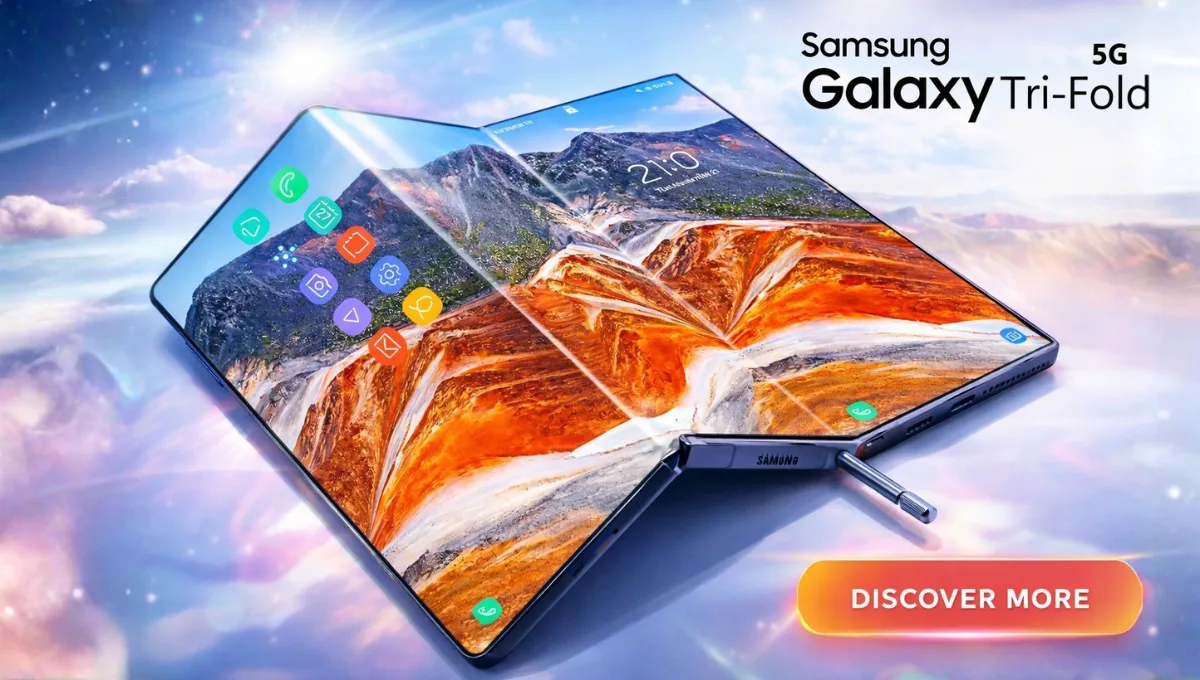
Samsung Galaxy Z Tri-Fold Phone: Samsung has officially launched its first tri-fold smartphone, the Galaxy Z TriFold, marking a significant evolution in the company’s foldable lineup. Announced in early December 2025, the device transforms from a standard-sized phone into a 10-inch tablet-like screen, directly challenging Huawei’s dominance in the tri-fold category.
The Galaxy Z TriFold arrives at a time when foldable phones are gaining traction but remain a premium niche. Priced at around $2,450 in South Korea, it went on sale there on December 12, 2025, with rollouts in select markets like China, Singapore, Taiwan, and the United Arab Emirates following soon after. A U.S. launch is planned for the first quarter of 2026, according to Bloomberg and Reuters reports.
This device underscores Samsung’s commitment to pushing foldable boundaries, building on a decade of experience that has made it the global leader in the segment.
A New Take on Folding
At the heart of the Samsung Galaxy Z TriFold is its unique folding mechanism. Unlike Huawei’s Mate XT series, which uses a Z-shaped fold that exposes part of the flexible screen on the outside, Samsung opted for a G-shaped inward-folding design with two hinges.
When fully unfolded, the Galaxy Z TriFold reveals a 10-inch main display about 25% larger than the inner screen on the Galaxy Z Fold 7, Samsung’s current book-style foldable. Folded completely, it offers a 6.5-inch cover screen on the exterior for everyday phone use.
This inward-folding approach prioritizes protecting the delicate main display from scratches and damage, a common concern with foldables. As Reuters noted in its December 2025 coverage, the design uses dual titanium hinges and an Advanced Armor Aluminum frame, making the device remarkably slim at 3.9mm in its thinnest section.
Hands-on reports from outlets like CNET highlight the clever engineering: the hinges are sized differently to accommodate the stacked panels, and software alerts prevent incorrect folding with vibrations and on-screen warnings. The result feels intuitive, with one hinge “popping” open responsively.
However, this choice means the Samsung Galaxy Z TriFold operates primarily in two modes fully closed or fully open unlike Huawei’s devices, which allow a partial unfold for a mid-sized screen. It’s a trade-off for durability over versatility.
Specs and Performance
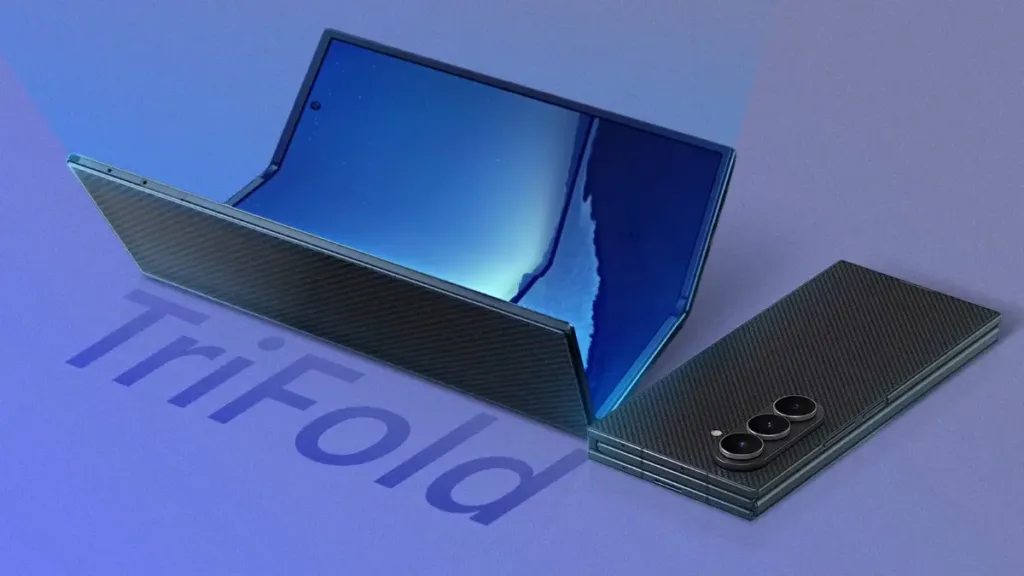
Samsung didn’t skimp on internals for its ambitious tri-fold phone.
The Galaxy Z TriFold is powered by a customized Snapdragon 8 Elite processor, the same chip found in Samsung’s top 2025 flagships. It supports up to 16GB of RAM and storage options reaching 1TB, positioning it as a productivity powerhouse.
The camera system borrows from Samsung’s best: a 200-megapixel main sensor, paired with ultrawide and telephoto lenses. Dual 10-megapixel selfie cameras cover both the inner and outer screens.
Battery life gets a boost with a 5,600mAh capacity spread across three cells one in each panel for better weight distribution and slimness. That’s larger than the Galaxy Z Fold 7’s battery and matches Huawei’s latest tri-fold.
The device carries an IP48 rating for water and limited dust resistance, plus Corning Gorilla Glass Ceramic 2 on the cover screen.
Brightness peaks at 2,600 nits on the outer display and 1,600 nits inside, ensuring usability outdoors. Running One UI on Android, it leverages Galaxy AI features optimized for the expansive screen, like advanced multitasking.
Also read:- SEC Championship 2025: Alabama and Georgia Set for Epic Rematch in Atlanta Title Clash
How It Stacks Up Against Huawei
Huawei beat Samsung to the tri-fold punch with the Mate XT in 2024, followed by the improved Mate XTs in 2025. Those devices use a single continuous screen that folds outward, offering more flexible configurations: phone mode, partial unfold, or full tablet.
The Samsung Galaxy Z TriFold counters with better screen protection and potentially superior durability. Reviews from CNET testers in Dubai noted minimal creases and a premium feel, though thicker bezels and a single color option (Crafted Black) make it look more utilitarian than Huawei’s sleeker designs.
Performance edges toward Samsung with its Snapdragon chip versus Huawei’s Kirin processors, and global software support is stronger outside China. Charging speeds favor Huawei in some models, but Samsung’s ecosystem integration seamless with Galaxy Watches, Buds, and laptops gives it an advantage for many users.
Pricing is comparable, with both hovering around $2,400-$2,900 depending on region and configuration. Early sales in South Korea sold out quickly, signaling strong initial demand despite the high cost.
Market Impact and Availability Challenges
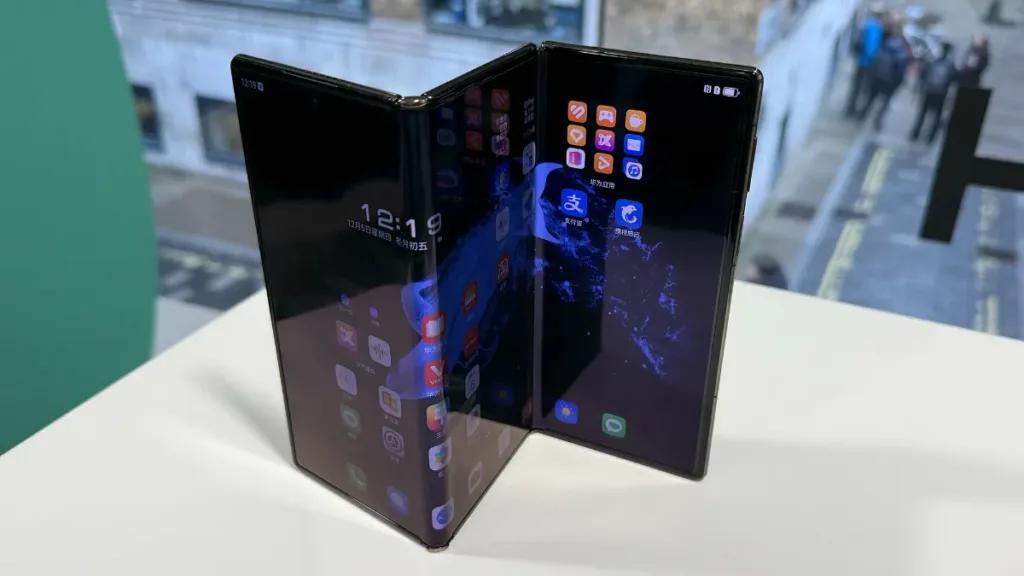
The launch reinforces Samsung’s foldable leadership at a pivotal moment. Foldable shipments grew modestly in 2025, but analysts expect acceleration as designs mature.
Reuters highlighted how the Galaxy Z TriFold could catalyze growth in the premium segment, even as overall smartphone sales remain flat. Samsung executives described it as targeted at enthusiasts rather than mass-market volumes, with limited initial production.
Availability reflects that caution: starting in South Korea and select Asian markets, plus the UAE. The delayed U.S. rollout, per Bloomberg, allows time to gauge response and ramp production.
Competition is heating up, with rumors of Apple entering foldables in 2026. Samsung’s move positions it ahead, showcasing engineering prowess while Chinese rivals like Huawei push boundaries in their home market.
Also read:-Android 17: Rumored Motion Sickness Relief Feature, Expected Release Date, Codename, and Updates
A Glimpse of Mobile’s Future?
The Samsung Galaxy Z TriFold isn’t for everyone its price and niche appeal ensure that. But it represents a tangible step toward devices that blur lines between phones, tablets, and even laptops.
For power users craving more screen real estate without carrying multiple gadgets, it delivers. Early adopters in launch markets have snapped it up, suggesting appetite for innovation persists.
As foldables evolve, compromises like thickness and cost should diminish. Samsung’s decade of refinement shines here, turning a once-fringe concept into something polished, if still exclusive.
Whether the Galaxy Z TriFold sparks broader adoption remains to be seen. For now, it’s a statement: Samsung isn’t content leading in traditional foldables it’s aiming to define the next era.