
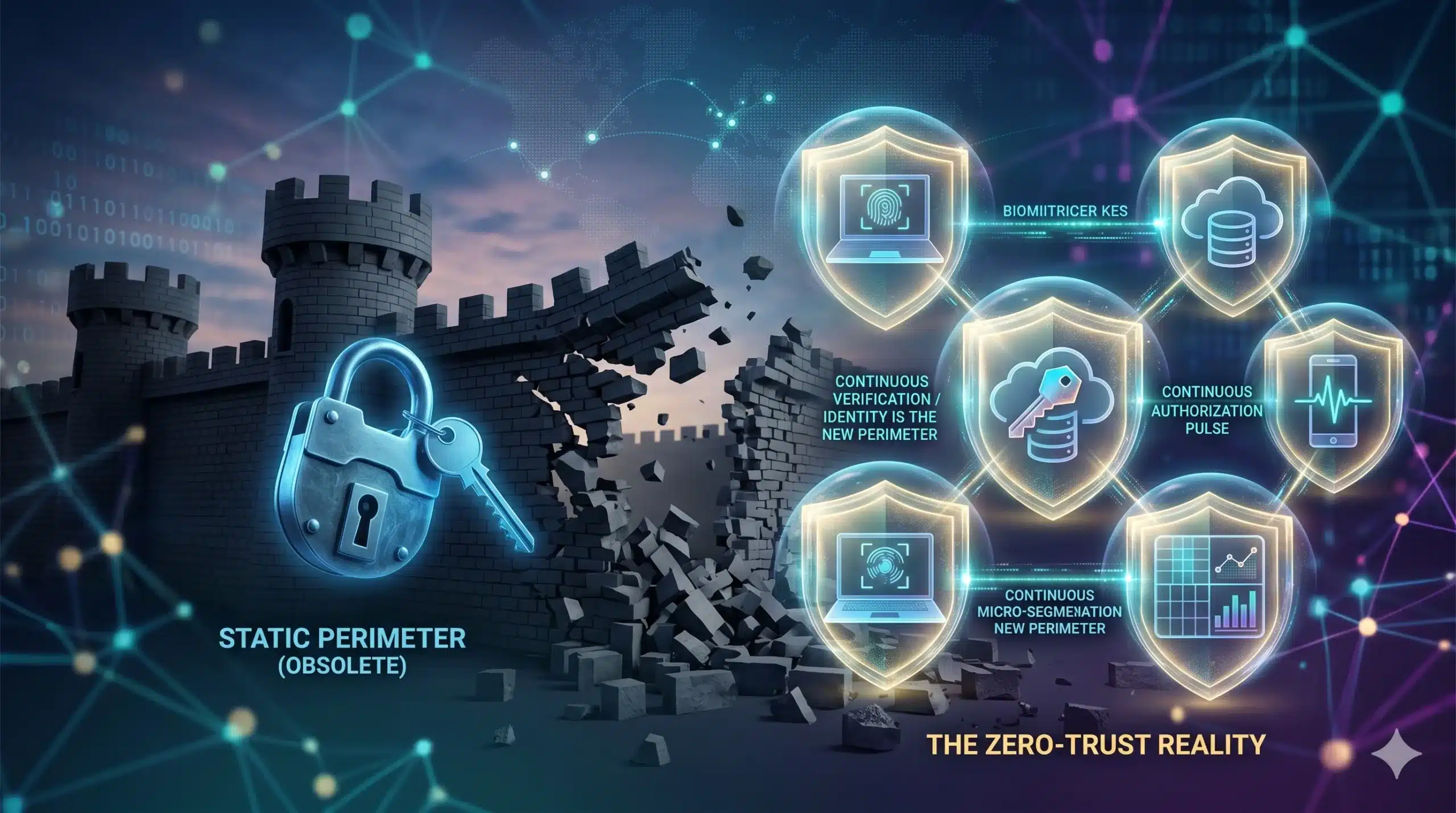
The corporate perimeter hasn’t just been breached; it has been dissolved. In the early 2020s, the “castle and moat” strategy—where everyone inside the office network was trusted and everyone outside was blocked—became a dangerous relic. Today, in 2026, your workforce is a constellation of coffee shops, home offices, and transient co-working spaces across global time zones. When the network is everywhere, the very concept of a “trusted location” is an invitation to disaster.
We are now living in the Zero-Trust Reality. This security philosophy operates on a single, uncompromising mandate: Never trust, always verify. In a world of decentralized teams, security is no longer about building a bigger wall around a building; it is about attaching a tiny, impenetrable wall around every individual user, every device, and every piece of data.
The “Why”: The Collapse of the Managed Network
The economic driver for Zero-Trust is the radical decentralization of the modern business ecosystem. For an entrepreneur managing a global portfolio—from digital publishing in India to sports blogs in Mozambique—the legacy VPN (Virtual Private Network) is a massive bottleneck. VPNs are often “all-or-nothing”; once a hacker steals one set of credentials, they have the keys to the entire kingdom.
Technologically, the shift is forced by the explosion of “Shadow IT” and the integration of unmanaged personal devices into professional workflows. Recent industry benchmarks suggest that over 70% of successful breaches now originate from compromised identities rather than technical exploits. As businesses prioritize scalability and remote flexibility, the cost of a single data leak often outweighs the total ROI of the project itself. Zero-Trust isn’t a luxury; it is the fundamental infrastructure of modern work.
Technical Breakdown: The Architecture ofConstantVerification
Zero-Trust is not a single software product, but a rigorous framework of interconnected technologies. It replaces the “one-time login” with a continuous, invisible interrogation of the user’s context.
Shutterstock
- Micro-Segmentation: The network is broken into tiny, isolated zones. Even if a breach occurs in a marketing tool, the attacker cannot “pivot” to the financial database or the source code repository.
- Least Privilege Access (ZTPR): Users are granted the absolute minimum level of access required to perform their current task, and only for the duration of that task.
- Identity-Centric Security: The “new perimeter” is identity. Access is determined by a combination of Multi-Factor Authentication (MFA), biometric verification, and device “health” checks.
- Contextual Risk Assessment: An AI-driven engine monitors behavior in real-time. If an employee who usually logs in from Odisha suddenly attempts to download the entire company database from an unrecognized IP in a different country, the system automatically terminates the session.
The Security Paradigm Shift
| Feature | Legacy Perimeter Security (Old Tech) | Zero-Trust Architecture (New Tech) |
| Trust Model | Binary (Inside vs. Outside) | Null (Assume Breach) |
| Verification | At Point-of-Entry | Continuous & Contextual |
| Visibility | Limited to Local Network | Total Visibility across Cloud/Edge |
| User Experience | Friction-heavy (Static VPNs) | Frictionless (Identity-driven) |
Real-World Impact: Security at the Edge
The integration of Zero-Trust allows businesses to hire talent anywhere without the fear of compromising their core assets. Consider a mobile game studio like Druvion Studio. Developers might be pushing code for “Last Armor: King Survival” from various locations using personal high-end rigs. In a Zero-Trust environment, the code repository is never exposed to the public internet; the developer is authenticated at the packet level, ensuring that the infrastructure remains invisible to the outside world.
For the consumer and the individual contractor, this means a “Log-in Once, Secure Everywhere” experience. Whether accessing a Binance account for a USDT transfer or managing a server for a digital domain, the security layers move with the user. It eliminates the need for complex, manual security configurations, allowing the focus to remain on creation and operations rather than firewall management.
Challenges & Ethics: The Privacy and Complexity Bottleneck
The move to total verification introduces new “bottlenecks,” particularly regarding the human element.
- The Surveillance Friction: Continuous monitoring can feel like “Big Brother.” There is a delicate ethical balance between monitoring a device’s health and infringing on a remote worker’s personal privacy.
- Implementation Debt: For many companies, the “legacy infrastructure” is not ready for Zero-Trust. Retrofitting old servers and proprietary software can be cost-prohibitive in the short term.
- Complexity Overload: If not managed correctly, Zero-Trust can become so restrictive that it kills the very scalability it was meant to protect, leading to “security fatigue” among employees.
The 3-5 Year Outlook: The Invisible Sentry
By 2029, Zero-Trust will no longer be a “feature” discussed by IT departments; it will be an invisible sentry baked into the silicon of our devices. The transition from “password” to “continuous biometric and behavioral identity” will be complete. We will stop thinking about “logging in” and start thinking about “authorized presence.”