
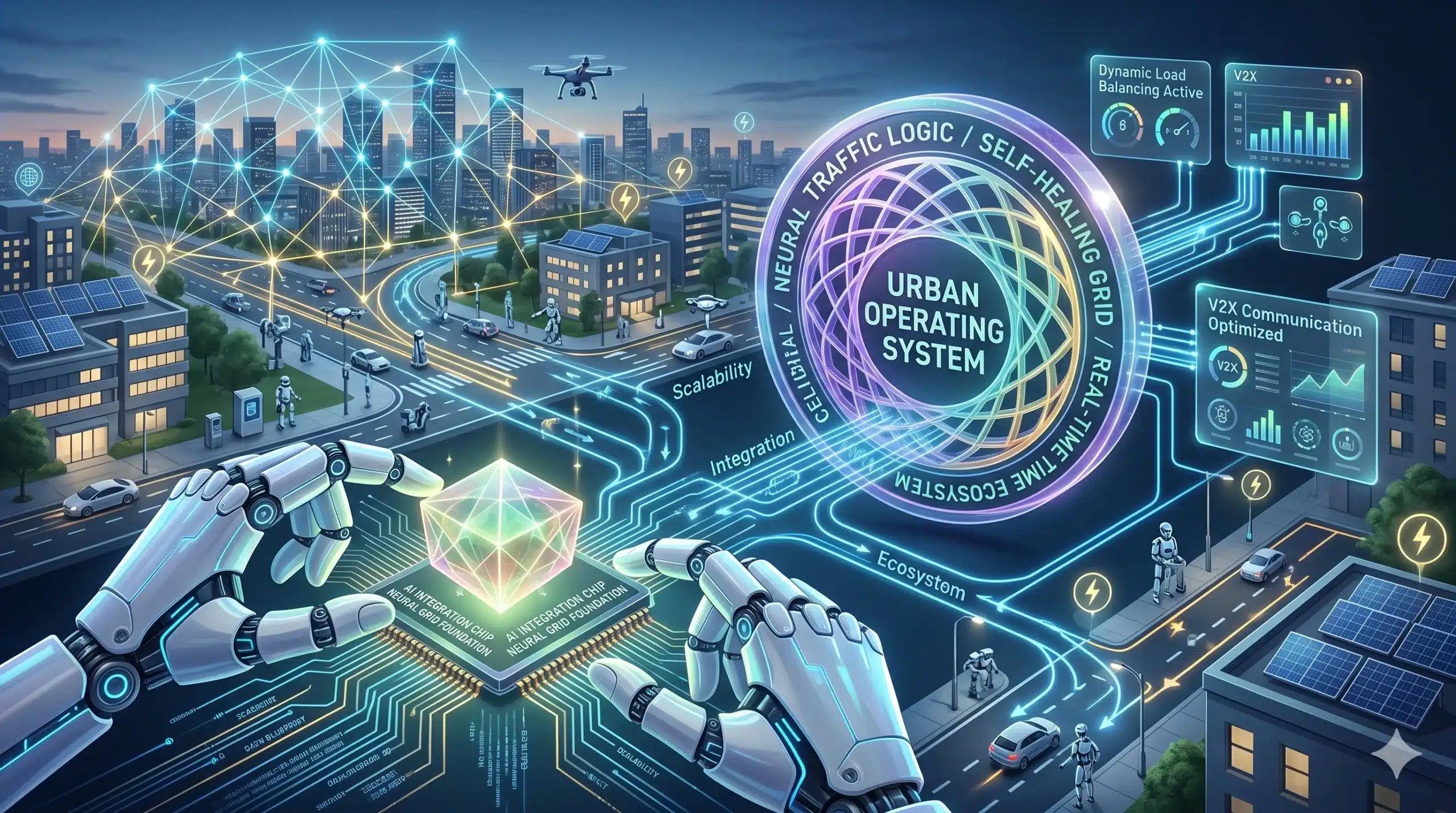
The modern city is a victim of its own success, choking on the very connectivity that built it. We have spent decades layering “smart” sensors onto crumbling Victorian-era plumbing and 20th-century power lines, but the result has often been a fragmented mess of data silos that can’t talk to one another. In 2026, a city is no longer just a collection of buildings; it is a massive, pulsing data engine that requires a unified operating system.
We are entering the era of Smart Cities 2.0. This isn’t about adding more cameras; it’s about the deep integration of artificial intelligence into the physical infrastructure. By turning traffic lights into neural nodes and power grids into self-healing markets, we are transforming the urban experience from a series of daily frictions into a fluid, responsive ecosystem.
The “Why”: The Collapse of Static Infrastructure
The economic shift toward Smart Cities 2.0 is driven by the sheer cost of urban inefficiency. Traffic congestion isn’t just an annoyance; it’s a multi-billion dollar drain on global GDP and a primary driver of urban carbon emissions. Simultaneously, our energy grids are buckling under the weight of electric vehicle (EV) adoption. A static grid designed for one-way power flow cannot handle a neighborhood where every driveway is a high-voltage charging station.
Technologically, we’ve reached a tipping point where Edge Intelligence and 5G density allow for real-time processing. Recent Gartner trends suggest that by 2028, over 60% of Tier-1 cities will utilize AI-driven “Digital Twins” to manage their core services. The ROI for these investments is found in the “found energy” and “found time”—the minutes and megawatts saved when a city stops reacting to problems and starts predicting them.
Technical Breakdown: The Neural Grid
Smart Cities 2.0 relies on a decentralized architecture that treats every streetlight, transformer, and vehicle as a participant in a giant, self-correcting loop.
- V2X (Vehicle-to-Everything) Communication: Low-latency 5G links that allow cars to “talk” to traffic signals and pedestrians’ smartphones, creating a 360-degree safety bubble.
- Dynamic Load Balancing (DLB): AI algorithms that monitor the energy grid in real-time, automatically shifting EV charging loads to off-peak hours or drawing power from parked vehicle batteries to prevent brownouts.
- Predictive Traffic Flow: Instead of fixed timers, intersections use computer vision to analyze live traffic volume and adjust signals to eliminate “ghost jams” before they form.
- Automated Demand Response: Smart appliances and industrial systems that communicate with the energy infrastructure, pausing high-energy tasks for a few minutes when the grid hits peak load in exchange for lower utility rates.
The Urban Evolution
| Feature | Smart Cities 1.0 (Legacy) | Smart Cities 2.0 (2026+) |
| Data Flow | Reactive / Manual | Proactive / Autonomous |
| Grid Model | Centralized / One-way | Decentralized / Bi-directional |
| Traffic Control | Fixed Timers / Loops | Real-time Neural Logic |
| Primary Goal | Digitization of Records | Optimization of Flow |
Real-World Impact: The Living City
The integration of these systems is already redefining urban life. In Traffic Management, a “Green Wave” isn’t just a lucky streak; it’s a calculated priority. Emergency vehicles can now “carve” a path through traffic as the AI preemptively clears the route, while public transit buses are prioritized to ensure maximum scalability of the transport network.
For the Energy Ecosystem, the city becomes a giant battery. Imagine a residential project in Odisha where a G+1 red brick house equipped with solar panels doesn’t just power itself—it sells excess energy back to the grid during the afternoon heat, which the AI then directs to a nearby cooling center. This creates a circular economy of energy that maximizes the ROI of every rooftop installation.
In Logistics, autonomous delivery drones and vans utilize the city’s neural map to navigate “micro-fulfillment” centers, avoiding schools during drop-off hours and heavy construction zones. This reduces the carbon footprint of the “last mile” and ensures that the city’s infrastructure remains uncluttered.
Challenges & Ethics: The Privacy and Energy Bottleneck
Despite the high-tech promise, Smart Cities 2.0 faces significant “bottlenecks” that are as much social as they are technical.
- The Surveillance Friction: To manage traffic, the city needs to see it. Balancing the need for computer vision with the individual’s right to Biometric Privacy is the most significant ethical challenge of the decade.
- Cybersecurity Risk: As we move the “brain” of the city onto the network, the threat of a “Q-Day” quantum attack on urban infrastructure becomes a national security concern, necessitating Quantum-Resistant Encryption.
- Energy Consumption of AI: Running the thousands of edge-compute nodes required for a 2.0 city is itself energy-intensive. Without a GreenOps strategy, the “Smart City” could end up consuming more power than it saves.
The 3-5 Year Outlook: The Invisible Utility
By 2030, the “Smart” in Smart City will be invisible. We will stop talking about it as a separate technology and start viewing it as a basic utility, as fundamental as clean water or paved roads. The city will become a silent partner in our daily lives—knowing when to dim the lights, when to speed up the bus, and how to keep the power flowing without human intervention.
The winners in this space will be the municipalities that prioritize Infrastructure Agility. As the climate changes and urban populations grow, the static city will break; only the neural city will survive. We aren’t just building better roads; we are building a city that finally knows how to think.