
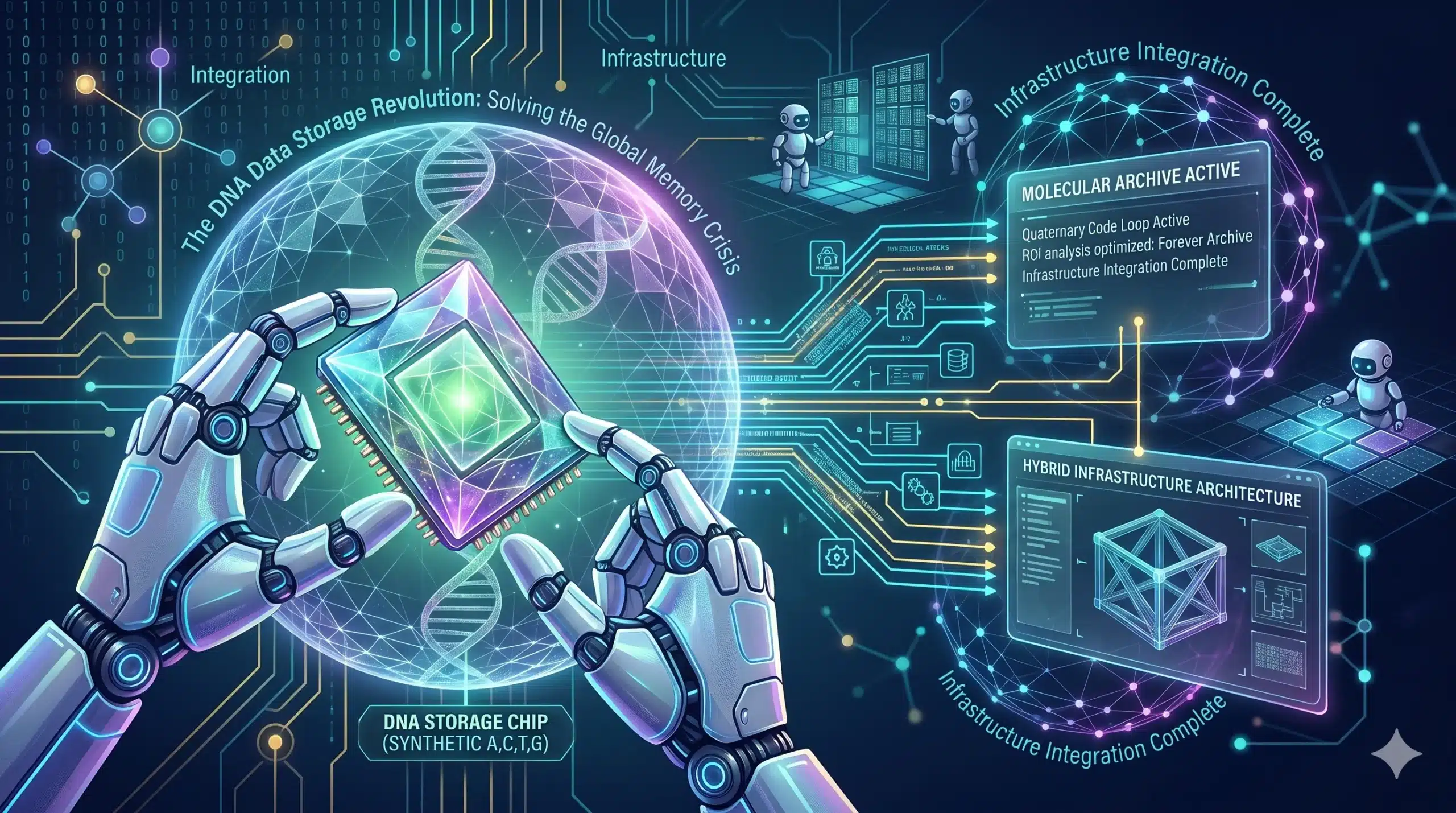
The world is running out of silicon. Every day, we generate over 300 million terabytes of data, yet the raw materials needed to build the hard drives and flash chips to store it are finite. As we approach 2026, the global “storage gap” has widened into a chasm; we are producing information faster than we can manufacture the infrastructure to hold it. Magnetic tape and spinning disks—the workhorses of the last century—are reaching their physical limits in terms of density and durability.
We are now looking toward the ultimate storage medium: DNA. Nature’s own hard drive has been archiving the blueprints of life for billions of years with an efficiency that makes our modern data centers look like primitive clay tablets. By encoding binary data into the four-base sequence of synthetic DNA, we are transitioning from a world of decaying plastic and metal to a medium that is compact, permanent, and theoretically limitless.
The “Why”: The Collapse of Magnetic Longevity
The economic drive for DNA data storage is fueled by the hidden cost of “data rot.” Current enterprise storage solutions have a depressingly short shelf life. Magnetic tape must be replaced every decade, and SSDs lose their charge if left unpowered. For organizations with massive cold-storage needs—national archives, healthcare systems, or global financial institutions—the recurring cost of migrating petabytes of data every few years is a massive drain on ROI.
Technologically, DNA offers a level of scalability that is orders of magnitude beyond current tech. You could theoretically store every byte of data currently on the internet inside a container the size of a sugar cube. In an ecosystem where data center land use and cooling energy are becoming significant environmental liabilities, the move to a storage medium that requires zero power once written is no longer a sci-fi dream—it’s a logistical necessity.
Technical Breakdown: From Binary to Biology
DNA data storage replaces the 0s and 1s of silicon with the A, C, T, and G of genetics. The process is a high-speed loop of synthesis and sequencing.
- Encoding: Software converts digital binary code into a quaternary code (00=A, 01=C, 10=G, 11=T).
- DNA Synthesis: Custom-built machines “print” these sequences into synthetic strands of DNA. These are not biological organisms; they are inert, lab-grown molecules.
- Encapsulation: The synthetic DNA is dehydrated and sealed in glass or metal capsules, protecting it from light, heat, and moisture. In this state, it can remain stable for thousands of years.
- Sequencing and Decoding: To retrieve the data, a standard DNA sequencer reads the strands, and a decoder translates the genetic bases back into binary bits for the computer to display.
The Storage Paradigm Shift
| Feature | Magnetic Tape / SSD (Legacy) | DNA Data Storage (2026+) |
| Data Density | ~10^12 bits/cm³ | ~10^18 bits/cm³ |
| Longevity | 10 – 30 Years | 1,000+ Years |
| Energy Use | Continuous (Cooling/Power) | Zero (Passive Storage) |
| Retrieval Speed | Milliseconds to Minutes | Hours to Days (Current) |
Real-World Impact: The “Forever” Archive
The integration of DNA storage is fundamentally changing how we value historical records. In Global Governance, national libraries are already testing DNA “vaults” to store humanity’s cultural heritage. Unlike digital formats that become unreadable as software evolves (think of the floppy disk), DNA is a universal format; as long as there are humans, we will have the technology to read it.
For the Digital Entrepreneur, DNA storage offers a way to manage “legacy infrastructure.” If you are running a digital publishing business with decades of high-resolution video and raw data archives, DNA allows you to “set it and forget it.” You can archive your entire business history in a single vial, ensuring a 100-year ROI without a single monthly cloud storage bill.
In Healthcare, the integration of DNA storage with personalized medicine is creating “living records.” A patient’s entire medical history, including high-resolution imaging and genomic data, could be stored within a synthetic DNA sequence that is physically attached to their medical file, ensuring the data is never lost, even if the hospital’s central servers are hit by a ransomware attack.
Challenges & Ethics: The Synthesis Bottleneck
Despite the staggering density, the DNA revolution faces two major “bottlenecks” that prevent it from replacing your phone’s memory just yet.
- The Cost of Writing: While reading DNA (sequencing) has become incredibly cheap thanks to the medical industry, writing DNA (synthesis) remains expensive. Until we achieve scalability in “printing” DNA strands, this tech will remain reserved for cold-storage archives rather than active workloads.
- Latency: DNA storage is slow. You won’t be running an operating system off a DNA strand anytime soon. It is a medium designed for data that needs to be kept forever but accessed rarely.
- Ethical Oversight: There are concerns about the “biosecurity” of synthetic DNA. Ensuring that data-storage DNA cannot be mistaken for—or integrated into—dangerous pathogens requires strict industry standards and algorithmic auditing.
The 3-5 Year Outlook: The Molecular Cloud
By 2029, we will likely see the first “Molecular Tiers” appearing in public cloud offerings. You will be able to select a “DNA Archive” option for data that you want to keep for 50+ years. The winners in this space will be the companies that can bridge the gap between biological synthesis and digital infrastructure.