
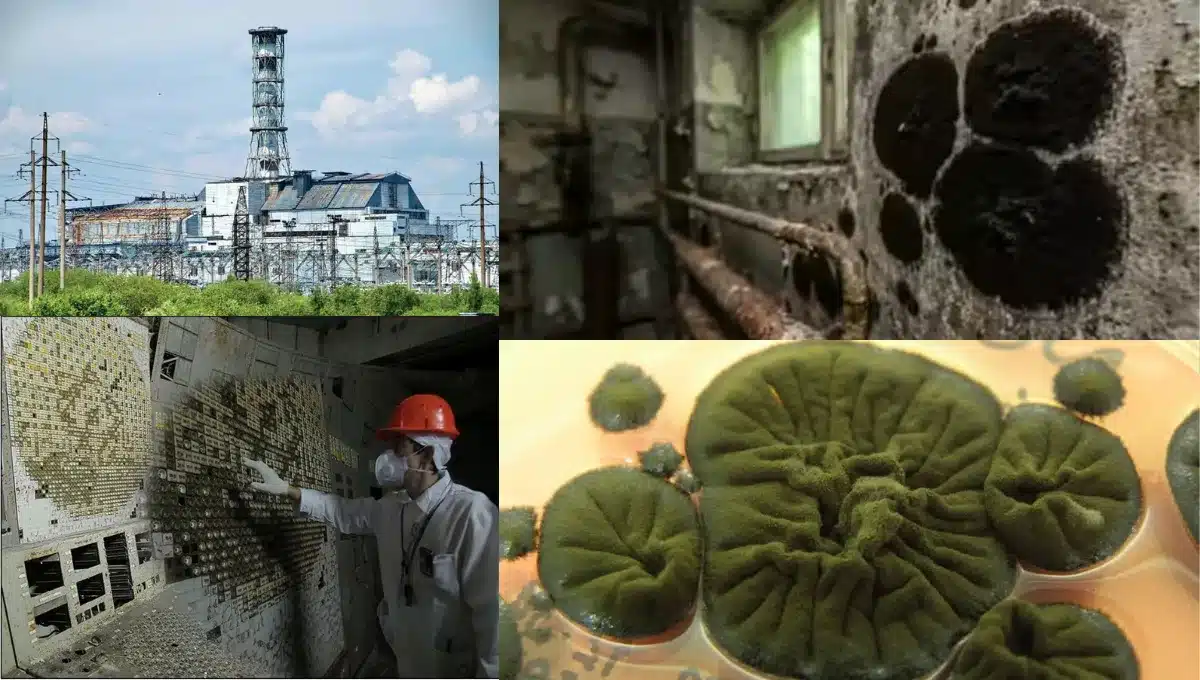
US News: In the shadowed ruins of Ukraine’s Chernobyl Nuclear Power Plant, where the 1986 disaster unleashed levels of radiation that still render the area off-limits to most life, a quiet revolution has been unfolding for decades. Black patches of mold, defying all expectations, have not only endured but flourished amid the gamma rays and fallout. These unassuming fungi, first spotted creeping across the reactor walls, are now captivating scientists worldwide for their uncanny ability to convert ionizing radiation, the very force that poisoned the zone, into a source of energy for growth. As research accelerates in late 2025, experts are eyeing this “radiotrophic” marvel as a potential game-changer for protecting astronauts on long-haul missions to Mars and beyond.
The story begins in the late 1990s, when mycologist Nelli Zhdanova and her team ventured into the heart of Reactor No. 4. What they found defied logic: dark, velvety growths of fungi blanketing surfaces saturated with radioactive particles. Soil samples from the exclusion zone revealed over 35 species drawn to the contamination, but one stood out: Cladosporium sphaerospermum, a melanin-rich black mold. Unlike typical fungi that might merely tolerate harsh conditions, this one appeared to seek out the radiation. Lab tests later confirmed it: when exposed to gamma rays at 500 times normal levels, the fungus ramped up its metabolism, accumulating biomass and acetate at an accelerated pace. It wasn’t just surviving the apocalypse; it was feeding off it.
At the core of this adaptation lies melanin, the pigment that gives the fungus its inky hue and also colors human skin and hair. In most organisms, melanin acts as a shield, absorbing harmful UV rays. But in Chernobyl’s extremophiles, it does something far more extraordinary. When gamma radiation strikes the melanin molecules in the fungal cell walls, it disrupts their electrons, sparking a cascade of chemical reactions that generate usable energy. Researchers, including Ekaterina Dadachova and Arturo Casadevall from Albert Einstein College of Medicine, dubbed this process “radiosynthesis” in a landmark 2007 study published in PLOS ONE. It’s eerily reminiscent of photosynthesis, where plants harness sunlight except here, the fuel is the invisible killer from a nuclear meltdown. “This isn’t passive protection,” Dadachova explained in follow-up interviews. “The fungus is actively exploiting the radiation, turning a toxin into a resource.”
Not all melanized fungi pull off this feat with equal flair. Early surveys showed variability: while Cladosporium sphaerospermum and relatives like Wangiella dermatitidis thrived under irradiation, others like Cladosporium cladosporioides produced more melanin but grew no faster. A 2022 study from Sandia National Laboratories added nuance, finding no universal growth boost across all exposed species, underscoring that evolution has fine-tuned this ability in Chernobyl’s most resilient survivors. Even more intriguing is “radiotropism,” the fungus’s tendency to direct its thread-like hyphae toward radiation sources, much like a plant bending toward the sun. Zhdanova’s 2000 research in Mycology documented this behavior in soil samples, ruling out simple nutrient-seeking and pointing to an innate pull toward the energy-rich rays.
Fast-forward to the International Space Station in 2020, and the fungus’s talents took on cosmic proportions. A team led by Nils Averesch grew Cladosporium sphaerospermum in petri dishes exposed to space’s unforgiving radiation. The results, detailed in Frontiers in Microbiology, were striking: beneath the fungal mats, radiation levels dropped significantly up to 2.42% less than controls, suggesting the mold not only withstands cosmic rays but actively attenuates them. On the ISS, the fungus outpaced its Earth-bound counterparts in growth, hinting at untapped potential in microgravity. NASA astrobiologist Lynn Rothschild, a vocal proponent of bio-based shielding, has called it a “lightweight, self-repairing alternative” to bulky metal barriers. For missions to the moon or Mars, where hauling heavy radiation shields is a logistical nightmare, a thin layer of this fungus could grow on demand, gobbling up harmful particles while sustaining itself on the very radiation it blocks.
As of December 2025, the buzz around Chernobyl’s black fungus shows no signs of fading. Recent analyses in journals like Current Opinion in Microbiology highlight ongoing puzzles, such as the exact pathways for ATP production or carbon fixation, but affirm its edge over non-melanized peers. Bioremediation experts see parallels for cleaning up nuclear sites on Earth, where the fungus could slowly “drink” away contamination without the risks of mechanical removal. Yet it’s the space angle that has ignited fresh funding from agencies like ESA and NASA, with proposals for scaled-up orbital tests slated for 2026.
In a world still grappling with the scars of nuclear mishaps, Cladosporium sphaerospermum offers a sliver of hope born from catastrophe. What began as an eerie sight in a forbidden zone could one day guard humanity’s leap to the stars, proving that even in the darkest fallout, life finds a way to not just endure, but innovate. As Dadachova put it, “Nature has handed us a tool we never knew we needed, one that’s as tough as the environment that forged it.”