
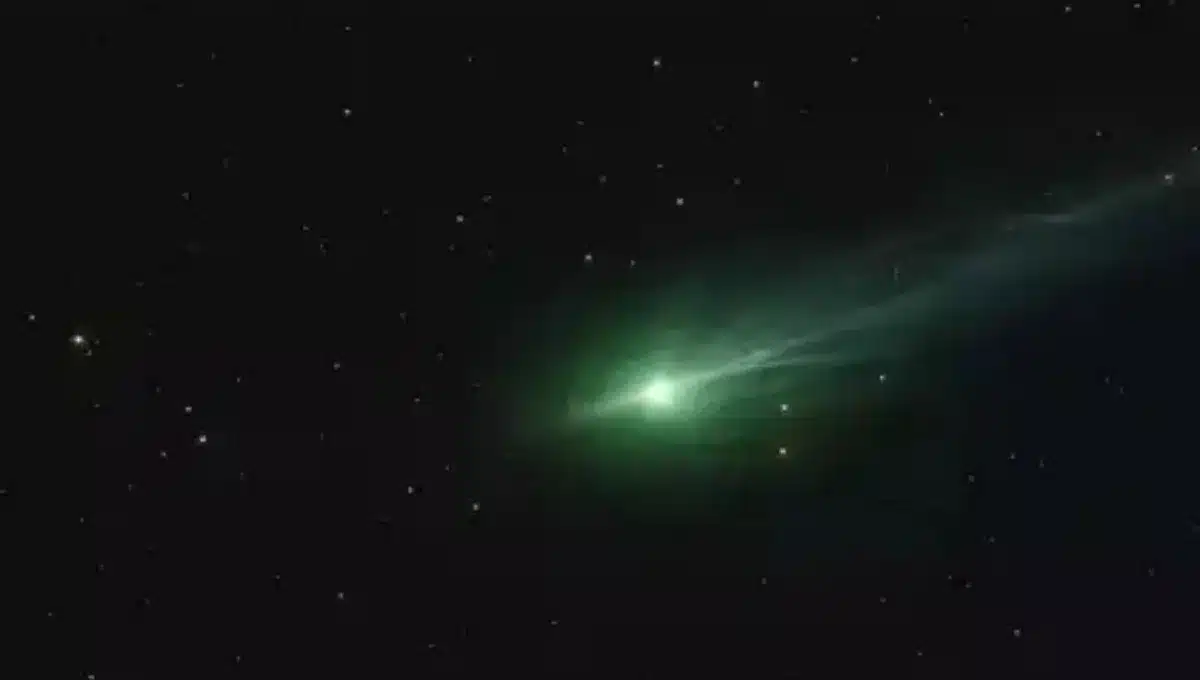
US NEWS: Space agencies are buzzing with excitement over the latest glimpses of 3I/ATLAS, the third confirmed interstellar comet to visit our solar system. This week, both NASA and the European Space Agency released captivating new images that highlight the comet’s increasing activity following its recent brush with the sun. With its closest pass by Earth slated for December 19, astronomers are making the most of this fleeting opportunity to study a true cosmic outsider.
First identified in early July by the Asteroid Terrestrial-impact Last Alert System, or ATLAS, telescope network, 3I/ATLAS was quickly verified as an interstellar object, originating from beyond our sun’s gravitational grasp. Since then, it has been racing through the inner solar system at speeds topping 130,000 miles per hour. The comet made its nearest approaches to Mars and the sun in October, experiences that superheated its icy surface and sparked dramatic outbursts of gas and dust.
Now, as it heads toward Earth at a safe distance of roughly 170 million miles, about 1.8 times the span between our planet and the sun, observatories are capturing unprecedented details. NASA’s Hubble Space Telescope delivered a standout image on November 30, taken from 178 million miles away. The shot centers on the comet’s bright nucleus and surrounding coma, a fuzzy halo of sublimating ices and particles that feeds into its tail. Streaks of background stars emphasize the comet’s blistering pace, while subtle jets of material hint at the intense solar warming it’s undergone.
Comets like this one grow more vivid near the sun, as heat causes their frozen components to vaporize and form those signature features. The European Space Agency contributed its own perspective through the Juice spacecraft, which is en route to explore Jupiter’s moons. An image from early November shows the comet in a lively state, with clear signs of jets erupting from its sunward side amid a growing envelope of debris.
These observations build on Hubble’s initial look back in late July, which appeared as little more than a hazy spot but helped pin down the comet’s dimensions. Estimates suggest it’s between 1,400 feet and 3.5 miles across, positioning it as potentially the largest interstellar visitor detected so far. Upcoming analyses of the coma’s makeup could reveal insights into the distant stellar system where 3I/ATLAS formed long ago.
Once it swings past Earth, the comet will continue its journey outward, eventually exiting the solar system forever. For scientists, this brief encounter offers a precious window into the universe’s far reaches, reminding us of the dynamic wonders that occasionally drop by from the stars.