
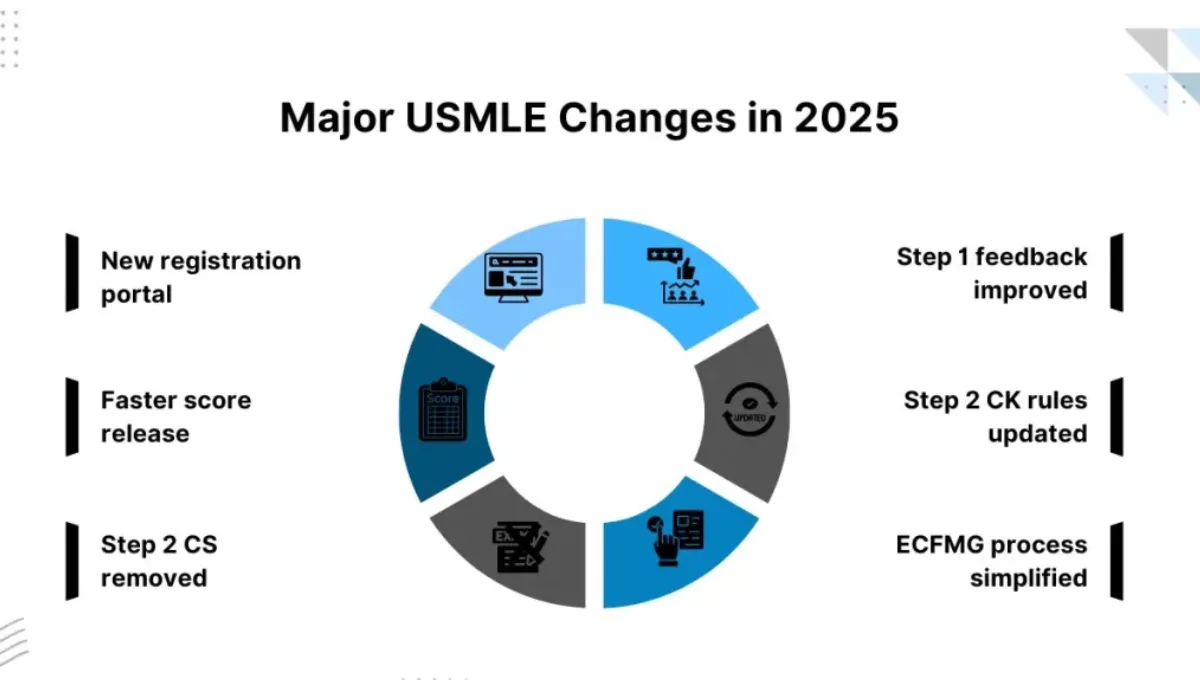
US News: The United States Medical Licensing Examination program is entering a new phase that will affect tens of thousands of medical students and graduates starting next month. On January 1, 2026, the Federation of State Medical Boards will assume responsibility for most USMLE services previously handled by the Educational Commission for Foreign Medical Graduates, marking the largest administrative shift in the exams history in more than a decade.
The change, jointly announced by the FSMB and the National Board of Medical Examiners, aims to create a more streamlined experience for test takers while maintaining the same rigorous standards that have defined the licensing process for years. Officials describe the transition as the final step in a multi-year effort to consolidate services under fewer organizations.
For international medical graduates, the impact will be immediate and substantial. Beginning in January, registration for Step 1 and Step 2 Clinical Knowledge, scheduling, eligibility extensions, testing region changes, and score reporting will all move to the FSMB platform. The organization already manages Step 3 applications for all candidates, so the expansion brings nearly the entire USMLE process for international applicants under one roof.
U.S. medical students and graduates will continue working directly with the NBME for Step 1, Step 2 CK, and Step 3 services, experiencing no change in their current workflow. The only universal constant remains that every candidate, regardless of graduation location, will apply for Step 3 through the FSMB.
Program leaders emphasize that exam content, scoring, and passing standards remain completely unchanged. The move is purely administrative and designed to reduce confusion, especially for applicants who previously navigated separate systems depending on their graduate status.
The timing aligns with other recent developments in international certification. The ECFMG now requires all 2026 pathways applicants to meet updated criteria released earlier this year, and the consolidated FSMB system is expected to simplify compliance tracking for both candidates and certifying bodies.
Medical school advisors across the country report that students have already begun adjusting their timelines. Many international graduates with active eligibility periods that extend into 2026 have received emails directing them to create FSMB accounts ahead of the switch. Canadian medical graduates from programs after July 1, 2025, now fall under the international category and will also use the new FSMB pathway.
Both organizations have launched a dedicated transition website with detailed timelines, frequently asked questions, and step-by-step guides. Officials strongly recommend that all affected applicants review their current status before the end of December to avoid delays during the busy winter testing window.
Residency program directors contacted by Signature School say they welcome the simplification. One Midwest program director noted that clearer documentation and faster score transmission could help reduce last-minute paperwork issues that sometimes complicate the Match process for international applicants.
The USMLE program has faced growing administrative complexity in recent years as the number of international medical graduates seeking U.S. licensure has steadily increased. Data from the National Resident Matching Program show that non-U.S. citizen international graduates now represent more than one in four matched applicants in many specialties.
While the service transition does not alter the exams themselves, it represents another milestone in the ongoing evolution of medical licensing in the United States. Students preparing for upcoming cycles are advised to monitor official channels closely over the next four weeks to ensure a smooth handover when the new system goes live on January 1.