
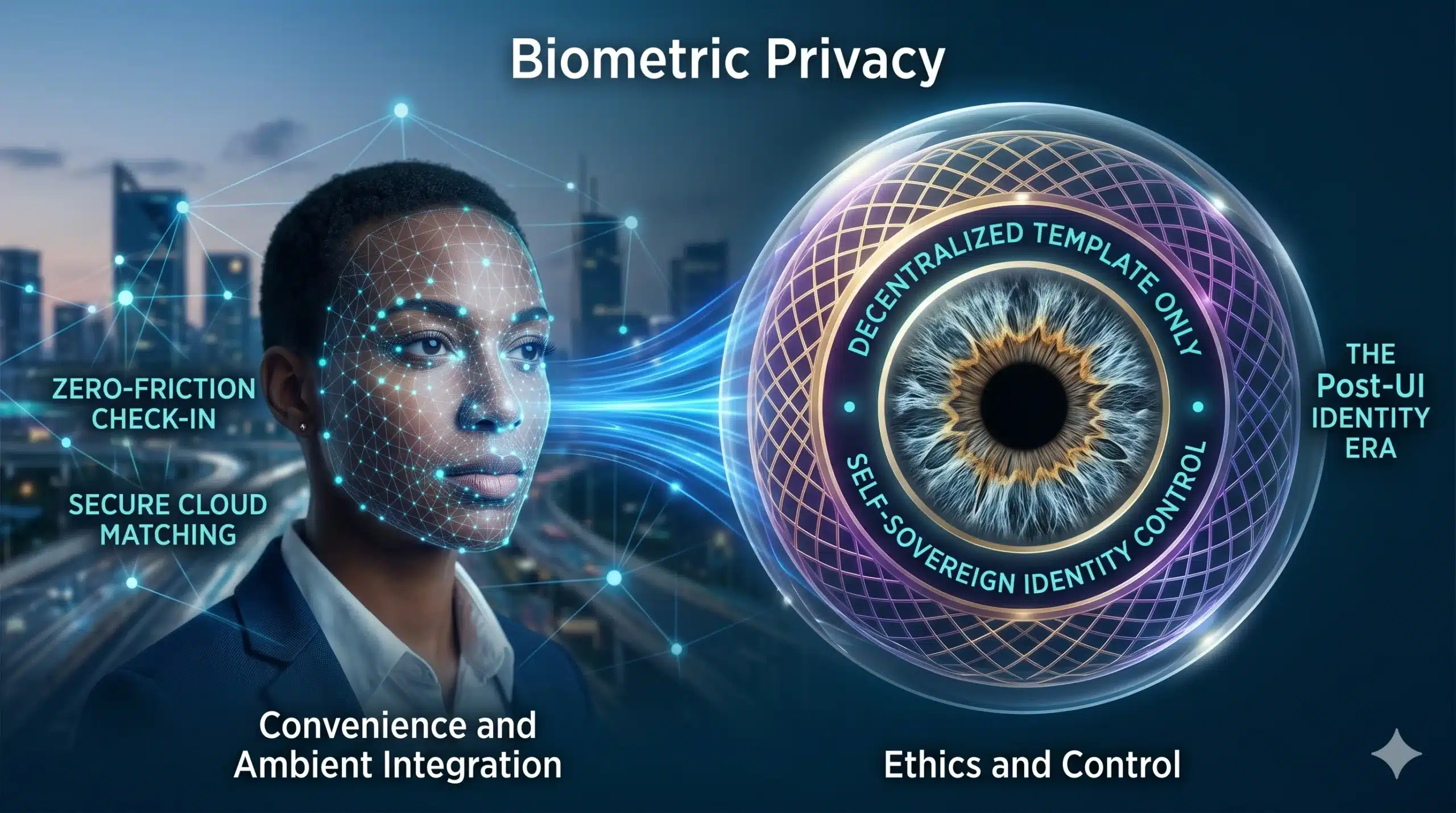
Your body is becoming your ultimate password, but unlike a string of characters, you can’t change your face if it gets hacked. In 2026, we have moved past the novelty phase of unlocking smartphones with a glance; biometrics now underpin the very infrastructure of global identity, from contactless airport transit to automated retail payments. As our physical features are digitized into searchable mathematical hashes, the line between convenience and constant surveillance has worn dangerously thin.
The stakes for Biometric Privacy have never been higher. As we integrate these technologies into every corner of the digital ecosystem, we are forced to confront a fundamental question: In the rush to eliminate friction from our lives, are we accidentally eliminating the right to remain anonymous in public spaces?
The “Why”: The Economic Engine of Identity
The shift toward pervasive facial and iris recognition is driven by the demand for “Zero-Friction” commerce. In an era where consumer attention is the scarcest resource, the ROI for a business that can identify a customer and process a payment without a card or a phone is immense. Recent Gartner trends suggest that by 2027, over 40% of global retailers will have piloted some form of biometric “gait or face” recognition to personalize the in-store experience.
Beyond retail, the technological push is a response to the “Identity Crisis” of the digital age. Traditional passwords and even physical IDs are prone to theft, loss, and deepfake manipulation. Biometrics—specifically iris scanning—offer a level of statistical uniqueness that traditional methods cannot match. For governments and large-scale enterprises, the scalability of a biometric-first identity system promises a future of reduced fraud and streamlined public services.
Technical Breakdown: Turning Biology into Bits
Modern biometric systems don’t store actual photos of your face or eyes; they store a “template”—a mathematical map of your unique biology.
- Nodal Point Mapping: Facial recognition software identifies roughly 80 nodal points on a human face, such as the distance between the eyes or the shape of the cheekbones, to create a “faceprint.”
- Iris Texture Analysis: Iris recognition uses near-infrared light to capture the intricate, chaotic patterns of the iris. These patterns are more stable over a lifetime than fingerprints and contain significantly more data points for verification.
- Liveness Detection: To prevent “spoofing” (using a photo or mask), high-end sensors check for micro-movements, pupil dilation, or blood flow to ensure the subject is a living, breathing human.
- On-Device vs. Cloud Matching: To improve integration and speed, many systems now perform “local matching,” keeping the sensitive biometric data on the user’s hardware rather than sending it to a central server.
The Identity Paradigm Shift
| Feature | Legacy Authentication (Old Tech) | Biometric Identity (2026+) |
| Primary Credential | Passwords / Physical Cards | Biological Markers (Face/Iris) |
| User Effort | Manual Input | Passive / Ambient |
| Security Risk | Credential Theft / Phishing | Data Permanence (Non-replaceable) |
| Infrastructure | Isolated Databases | Interconnected Biometric Hubs |
Real-World Impact: The Seamless Society
The integration of biometric systems is creating a “heads-up” society where your presence is your permission. In Travel, “Digital Travel Credentials” allow passengers to move from the curb to the plane without ever showing a passport. The system recognizes the traveler’s face at every touchpoint, checking it against a secure government infrastructure in real-time, drastically reducing wait times and improving airport efficiency.
For the Digital Entrepreneur, biometrics are the ultimate security layer for decentralized work. Imagine a developer in Odisha accessing a high-security server for a project like “Last Armor: King Survival.” Instead of a clunky VPN and MFA token, a quick iris scan on their laptop ensures that only the authorized creator is viewing the source code, providing an ironclad audit trail for global agencies.
In Smart Cities, facial recognition is being used to manage public transit flow and even “pay-by-face” at local kiosks. While this offers incredible convenience for the average commuter, it also means that a person’s movements through a city can be tracked with a level of precision that was previously impossible.
Challenges & Ethics: The Bottlenecks of Consent
The road to a biometric future is blocked by significant ethical “bottlenecks” that technology alone cannot solve.
- The Permanence Problem: If a database of faceprints is breached, those users cannot “reset” their faces. This creates a lifelong security risk that current legal frameworks are struggling to address.
- Algorithmic Bias: Despite improvements, many facial recognition models still show higher error rates for people of color. Integrating biased infrastructure into law enforcement or hiring can codify systemic discrimination.
- The Erosion of Anonymity: When every streetlight is potentially a biometric sensor, the concept of “walking anonymously in a crowd” disappears. This has profound implications for civil liberties and the right to peaceful protest.
The 3-5 Year Outlook: The Fight for “Self-Sovereign” Identity
By 2029, the battle will likely move from “whether” to use biometrics to “who” owns the data. We are seeing the rise of Self-Sovereign Identity (SSI), where biometric templates are encrypted and stored in a decentralized “wallet” controlled exclusively by the user.
b