
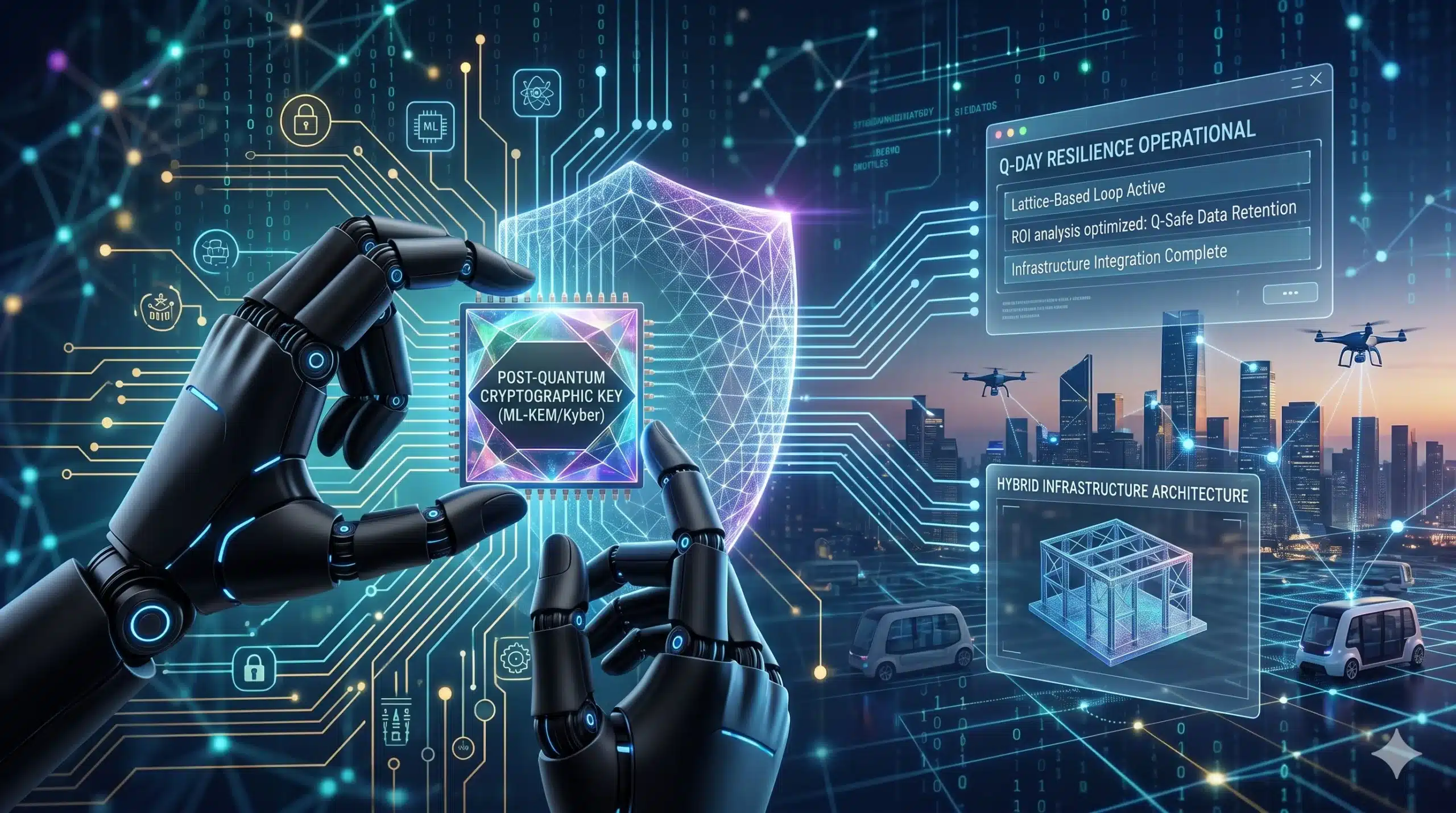
The locks on our digital world are based on a simple, comforting lie: that some math problems are just too hard to solve. For decades, the safety of your bank transfers, private medical records, and encrypted WhatsApp messages has relied on the fact that even the world’s fastest supercomputers would take billions of years to factor a 2048-bit prime number. But in the labs of Big Tech and global superpowers, a new kind of machine is being built that doesn’t just calculate faster—it thinks differently.
We are approaching Q-Day: the theoretical moment a cryptographically relevant quantum computer (CRQC) becomes powerful enough to shatter current encryption standards like RSA and ECC in seconds. While the “Day” itself may be a few years off, the threat is already active. Through “Harvest Now, Decrypt Later” (HNDL) attacks, adversaries are stealing encrypted data today, waiting for the hardware of tomorrow to unlock it. The race to implement Quantum-Resistant Encryption—also known as Post-Quantum Cryptography (PQC)—is no longer a theoretical exercise; it is a race for digital survival.
The “Why”: The Collapse of Mathematical Moats
The transition to PQC is driven by a fundamental shift in the technological ecosystem. Traditional public-key cryptography (RSA and Elliptic Curve) is vulnerable to Shor’s algorithm, a quantum process that bypasses the “difficulty” of factoring large numbers. For any organization with data that must remain secret for 10 or more years—such as government intelligence, long-term trade secrets, or healthcare records—the ROI of staying with legacy encryption is rapidly dropping toward zero.
Technologically, the push reached a turning point in late 2024 when the National Institute of Standards and Technology (NIST) finalized its first set of PQC standards. By 2026, regulatory bodies in the EU and North America have begun mandating PQC roadmaps for critical infrastructure. The shift isn’t just about security; it’s about “crypto-agility”—the ability to swap out broken algorithms without a total system redesign.
Technical Breakdown: The Architecture of Quantum-Proofing
PQC does not rely on quantum physics to protect data; instead, it uses mathematical problems that are “quantum-hard.” These are problems that even a quantum computer cannot solve efficiently.
- Lattice-Based Cryptography: The current frontrunner (e.g., ML-KEM/Kyber). It relies on the “Shortest Vector Problem” in high-dimensional grids (lattices), which remains exponentially difficult for both classical and quantum machines.
- Hash-Based Signatures: These utilize the security properties of cryptographic hashes. While Grover’s algorithm can speed up a “brute-force” search on a hash, doubling the key length (e.g., moving to AES-256) effectively mitigates the quantum threat.
- Multivariate Cryptography: Based on the difficulty of solving systems of multivariate polynomial equations.
- Hybrid Implementation: Most 2026 deployments are “hybrid,” wrapping a PQC layer around a classical RSA/ECC layer. This ensures that if the new PQC algorithm is found to have a flaw, the data is still protected by the legacy standard.
The Cryptographic Shift: Legacy vs. PQC
| Feature | RSA-2048 / ECC-256 (Legacy) | Lattice-Based (ML-KEM/ML-DSA) |
| Primary Math Problem | Integer Factorization / Discrete Logs | Shortest Vector Problem (Lattices) |
| Quantum Vulnerability | Critical (Shor’s Algorithm) | Quantum-Resistant |
| Key Generation Speed | Slow (High compute) | 10x – 15x Faster |
| Signature Size | Small (256 – 512 bytes) | Large (2.4KB – 3.5KB) |
| Computational Efficiency | Resource Intensive | Cache-friendly / Low Latency |
Real-World Impact: From Global Finance to Personal Data
The integration of PQC is moving from the server room to the palm of your hand. In Global Finance, banks are already piloting hybrid TLS (Transport Layer Security) handshakes for cross-border transactions. For an entrepreneur managing cross-border USDT payments via Binance, PQC ensures that the transfer instructions cannot be intercepted and “saved for later” decryption.
In Digital Publishing, content provenance systems are adopting PQC-based digital signatures. This ensures that the “seal of authenticity” on a video or article remains valid for decades, even as quantum computing power grows.
For the Consumer, PQC is becoming the new standard for “long-lived” data. Your cloud-stored family photos and personal emails are being migrated to quantum-safe infrastructure by major providers, ensuring that your digital history isn’t suddenly exposed in 2030 when a million-qubit processor comes online.
Challenges & Ethics: The Complexity Bottlenecks
Transitioning the world’s infrastructure to PQC is an engineering feat on par with the Y2K fix, but with higher stakes.
- The “Rip and Replace” Cost: Many legacy systems—especially in industrial IoT and power grids—have encryption hard-coded into the silicon. Replacing this hardware represents a massive capital expenditure.
- Network Overhead: PQC signatures and keys are significantly larger than RSA/ECC. This increase in data size can strain limited bandwidth in remote areas, like rural Odisha or Mozambique, requiring localized scalability optimizations.
- The Expertise Gap: There is a global shortage of cryptographers who understand lattice-based math. Implementing PQC incorrectly can lead to “side-channel” attacks that are just as dangerous as a quantum break.
The 3-5 Year Outlook: The Era of Crypto-Agility
By 2029, we will see the “Great Migration” move from the pilot phase to the default state of the web. The winners in this space will be the companies that treat encryption as a fluid service rather than a static piece of infrastructure.