
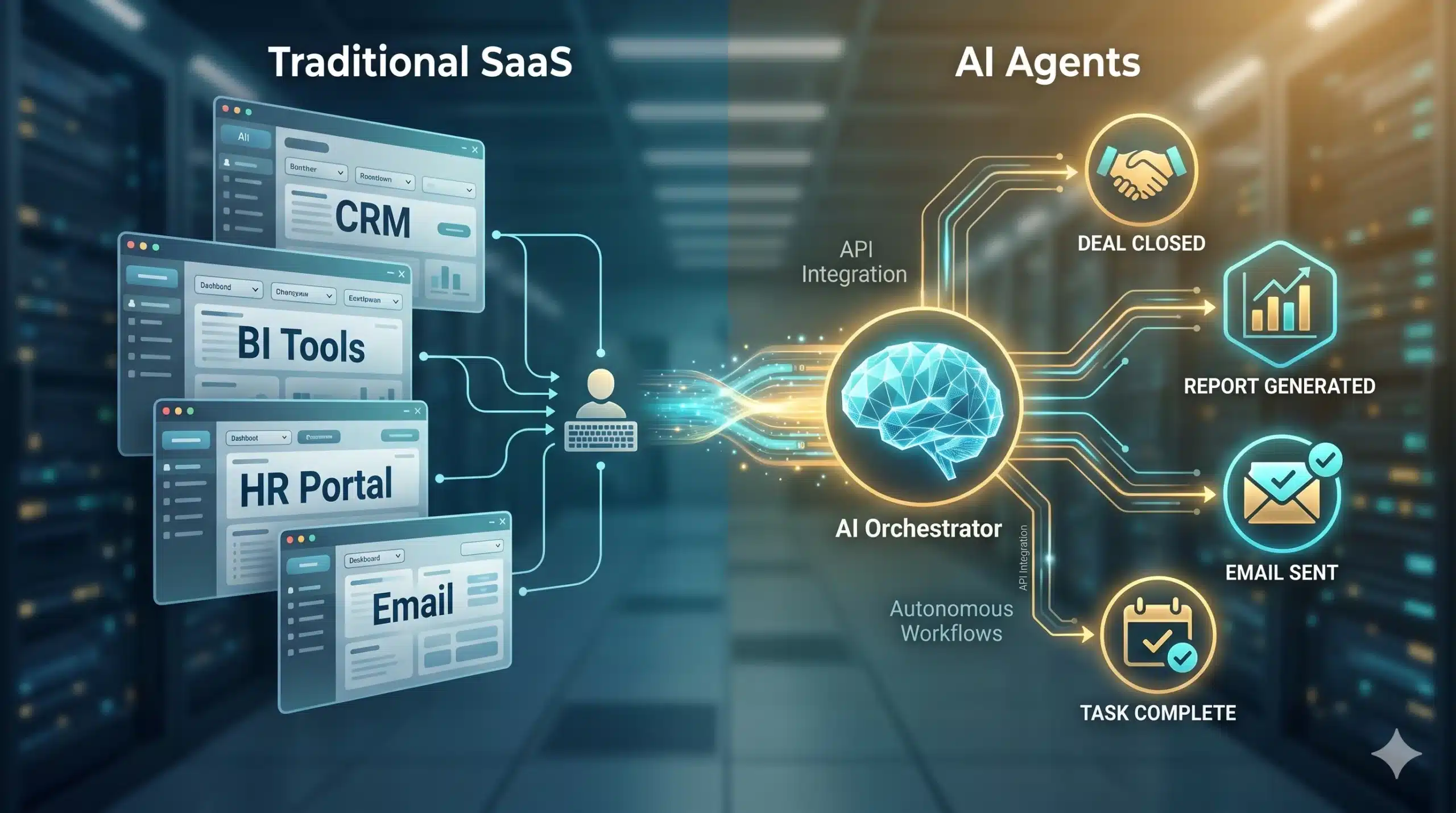
The “Software as a Service” (SaaS) model is being suffocated by its own success. We have reached a point of “app fatigue” where the average enterprise utilizes over 300 different SaaS applications, each with its own login, its own distinct UI, and its own monthly subscription fee. For the end user, this has created a fragmented digital experience where productivity is lost in the “toggle tax”—the mental friction of switching between tabs just to move data from point A to point B.
We are witnessing the beginning of the “post-UI” era. The traditional model of human-to-interface interaction is being bypassed by AI Agents. These autonomous entities don’t just sit behind a dashboard waiting for a click; they navigate the infrastructure of the web on your behalf. If an agent can execute a task across five different platforms without you ever seeing a single login screen, the value of the individual subscription interface begins to evaporate.
The “Why”: The Death of the Dashboar
The economic shift driving this trend is the realization that businesses don’t actually want “software”—they want outcomes. Historically, a subscription to a CRM like Salesforce or a marketing tool like HubSpot was a payment for access to a set of features. However, those features required a human operator to log in and do the work. This created a ceiling for ROI; the software was only as valuable as the time a human could spend inside it.
Technologically, the advent of Large Action Models (LAMs) has fundamentally changed the math. We no longer need a human to act as the “glue” between different parts of a digital ecosystem. When an AI can understand the intent of a request and has the “fingers” (via APIs and browser-level control) to execute it, the individual SaaS interface becomes a vestigial organ. The “moat” that software companies built using proprietary UIs is being bridged by agents that treat the entire web as a single, unified operating system.
Technical Breakdown: From Interface to Execution
The transition from SaaS to Agentic Services relies on a shift from “Graphic User Interfaces” (GUI) to “Large Language Model Actions.”
- Semantic Layering: Agents use a semantic understanding of a task (e.g., “Find a flight and book it within budget”) rather than following a rigid path of buttons.
- Headless Integration: Instead of rendering a webpage for a human, agents communicate directly with “headless” versions of software or via deep integration layers that bypass the visual frontend entirely.
- Orchestration Protocols: New protocols, such as the Model Context Protocol (MCP), allow different agents to “talk” to one another, sharing data across previously siloed platforms without manual data entry.
- Dynamic UI Generation: When a human does need to be involved, the agent generates a temporary, purpose-built interface—showing only the data needed for a specific decision—and then dissolves it.
The SaaS Paradigm Shift
| Feature | Legacy SaaS (2010–2024) | Agentic Services (2026+) |
| Primary Interface | Manual Dashboard (GUI) | Natural Language / Autonomous |
| User Interaction | Task-based (Click/Type) | Intent-based (Goal Setting) |
| Data Flow | Siloed (API required) | Fluid (Agent-to-Agent) |
| Billing Model | Per User / Per Month | Per Outcome / Per Compute |
Real-World Impact: The “Invisible” Enterprise
The impact of this shift is most profound in high-volume, low-margin digital operations. Consider a Digital Entrepreneur managing a sports news network in Mozambique. Under the old SaaS model, they would need subscriptions for an auto-blogging tool, a translation service, an SEO optimizer, and a social media scheduler. They would spend hours every week logging into each to ensure they are synced.
In the agentic era, they maintain a single “Agentic Orchestrator.” The agent identifies trending sports topics in Portuguese, generates the content, optimizes it for the local infrastructure, and publishes it across the network. The entrepreneur never sees the “interface” of the underlying tools. The SaaS providers become “commodity utilities,” providing the raw data or the publishing pipeline, while the agent captures the primary relationship with the user.
For consumers, this looks like the death of the “App Store.” Instead of 50 apps on a home screen, there is one intent-box. Whether you want to order food, book a Suzuki scooter service, or research red brick costs for a G+1 house in Odisha, the agent handles the multi-step integration across various services silently in the background.
Challenges & Ethics: The “Black Box” Economy
The move away from visible interfaces introduces significant scalability and trust “bottlenecks.”
- The Transparency Gap: If you never see the software’s UI, how do you know the agent is making the best choice? There is a risk that agents will prioritize services they are “partnered” with rather than the one that provides the best value to the user.
- Inference Costs: Moving away from static UIs toward dynamic, reasoning agents requires massive compute power. This could lead to a “Two-Tier Internet” where only those who can afford high-end agentic subscriptions have access to true efficiency.
- Security & Identity: How does an agent prove it has the authority to spend your money or access your private Gmail data without a human-mediated login? Solving “Agentic Identity” is the primary hurdle for the next three years.
The 5-Year Outlook: The Rise of the Outcome Economy
By 2030, the “SaaS” acronym may be replaced by “AaaS”—Agents as a Service. The software companies that survive will be those that stop building pretty dashboards and start building the most robust, agent-friendly APIs.