
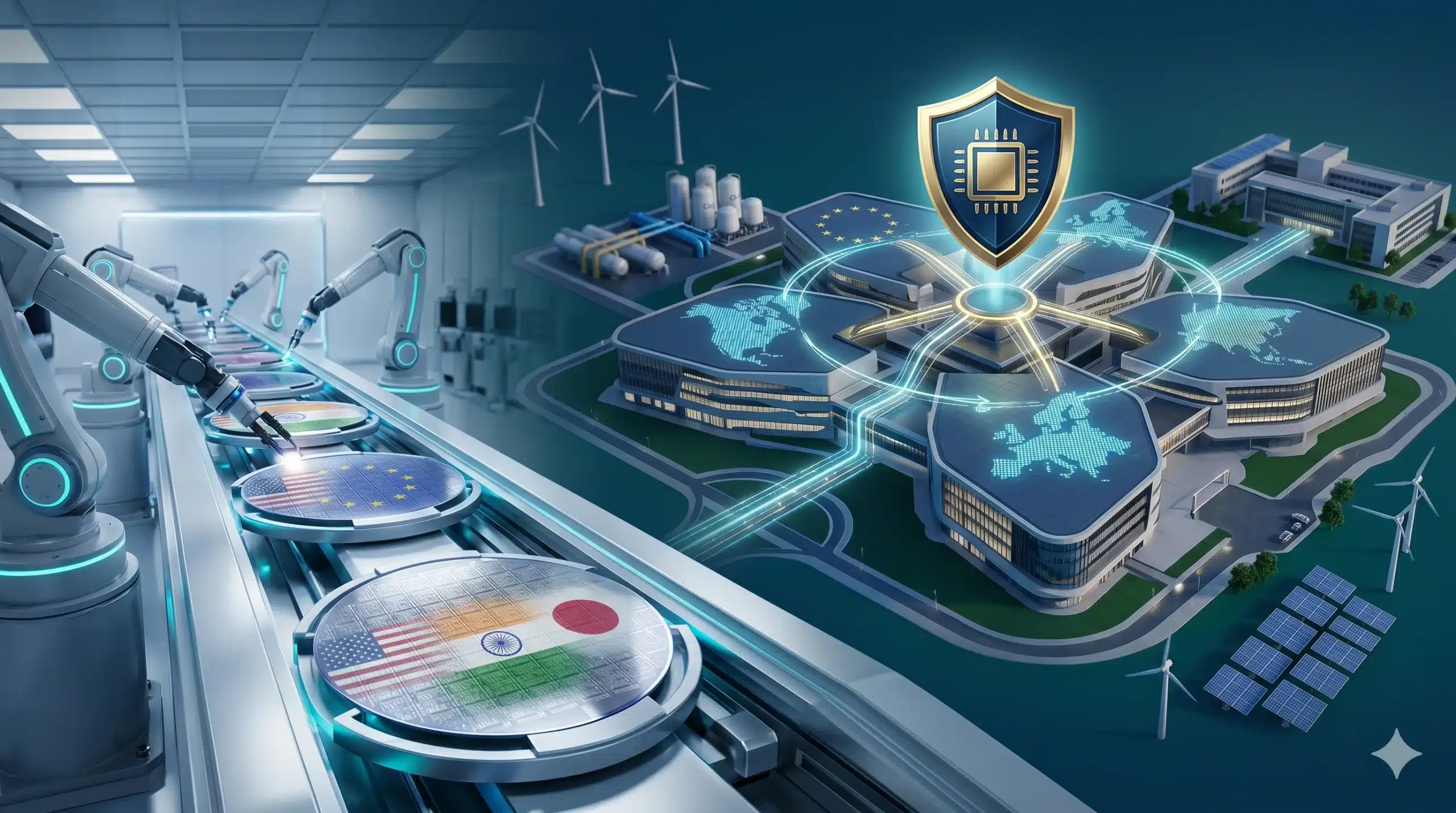
The globalization of the semiconductor industry has hit a wall of geopolitical reality. For decades, the tech world operated on a fragile, just-in-time logic: design in California, manufacture in Taiwan, and assemble in China. This hyper-efficient “single-point-of-failure” model worked untilit didn’t. Between pandemic-induced shortages and escalating trade wars, the world realized that if you don’t control the silicon, you don’t control your future.
We have entered the era of Silicon Sovereignty. Nations are no longer content to be customers of a global supply chain; they are racing to become its masters. From the U.S. CHIPS Act to the European Chips Act and India’s semiconductor missions, the goal is clear: domesticate the most complex manufacturing process on Earth to insulate national infrastructure from global shocks.
The “Why”: Chips as the New Oil
The shift toward domestic manufacturing is driven by the realization that semiconductors are the fundamental “atom” of the modern economy. Whether it is an AI data center, an electric vehicle, or a voice-changing keypad phone, everything runs on silicon. Relying on a single geographic region for 90% of advanced logic chips is now viewed as a national security risk equivalent to relying on a single hostile nation for energy.
Economically, the push is about capturing the ROI of the AI boom locally. As the demand for specialized AI accelerators and power-efficient LFP battery management chips skyrockets, governments want the high-paying jobs and the secondary ecosystem—the chemicals, gases, and specialized machinery—to reside within their borders. Silicon is no longer just a component; it is the foundation of digital autonomy.
Technical Breakdown: The Anatomy of a Fab
Building a domestic semiconductor infrastructure isn’t just about building a factory; it’s about creating a “Sub-Atomic City.” A modern fabrication plant (Fab) is perhaps the most complex human endeavor currently in operation.
- Extreme Ultraviolet (EUV) Lithography: The “printing press” of the silicon world. These machines use light with a wavelength of 13.5 nanometers to carve patterns into silicon that are thousands of times thinner than a human hair.
- Cleanroom Precision: Fabs operate at “Class 1” cleanliness, meaning there is less than one speck of dust per cubic foot of air. A single skin cell can destroy a multimillion-dollar wafer.
- Specialized Chemicals & Gases: Domesticating chips requires localizing the supply of ultra-pure photoresists, hydrofluoric acid, and rare earth elements.
- Packaging and Heterogeneous Integration: The trend is moving toward “Chiplets”—stacking smaller, specialized chips on top of each other to improve scalability and performance without needing a single, massive die.
The Semiconductor Manufacturing Shift
| Feature | The Globalized Model (Legacy) | Silicon Sovereignty (2026+) |
| Supply Chain | Fragile / Just-in-Time | Resilient / Redundant |
| Manufacturing Hubs | Centralized (East Asia) | Decentralized (Global Clusters) |
| Geopolitics | Economic Interdependence | National Digital Autonomy |
| Focus | Efficiency & Cost | Security & Reliability |
Real-World Impact: Resilient Local Economies
The integration of domestic chip production will stabilize industries that were previously at the mercy of the “Bullwhip Effect.” In the Automotive sector, Indian manufacturers—including those producing budget-friendly scooters or EVs—will no longer face eighteen-month wait times for simple microcontrollers. Localized production means that the firmware and hardware can be co-designed for specific regional needs, such as high-heat tolerance for LFP batteries in tropical climates.
For the Digital Entrepreneur, Silicon Sovereignty means more predictable hardware costs for the servers and mobile devices that power their MozStriker blogs or zombie survival games. When the supply chain is domestic, the volatility of international shipping and customs disappears, allowing for tighter financial planning and better long-term scalability.
Challenges & Ethics: The Massive “Bottlenecks”
The path to sovereignty is paved with massive financial and environmental obstacles.
- The Talent Gap: You can buy the machines, but you cannot easily “buy” a workforce. There is a global shortage of lithography engineers and cleanroom technicians. Training a domestic “silicon class” takes a decade of education-to-industry integration.
- The Energy Paradox: A single large Fab consumes as much electricity as a small city. Balancing the push for domestic chips with national “GreenOps” and carbon-neutral goals is a significant political friction point.
- Water Scarcity: Chip manufacturing requires millions of gallons of ultra-pure water daily. In regions like Odisha or the American Southwest, the competition between industrial water needs and agricultural survival is an ethical minefield.
The 3-5 Year Outlook: The Era of Localized Logic
By 2030, the semiconductor map of the world will look unrecognizable. We will see “Silicon Corridors” in the EU, the US, India, and Japan that mirror the industrial clusters of the 20th century. While Taiwan will remain a critical node, it will no longer be the only node.