
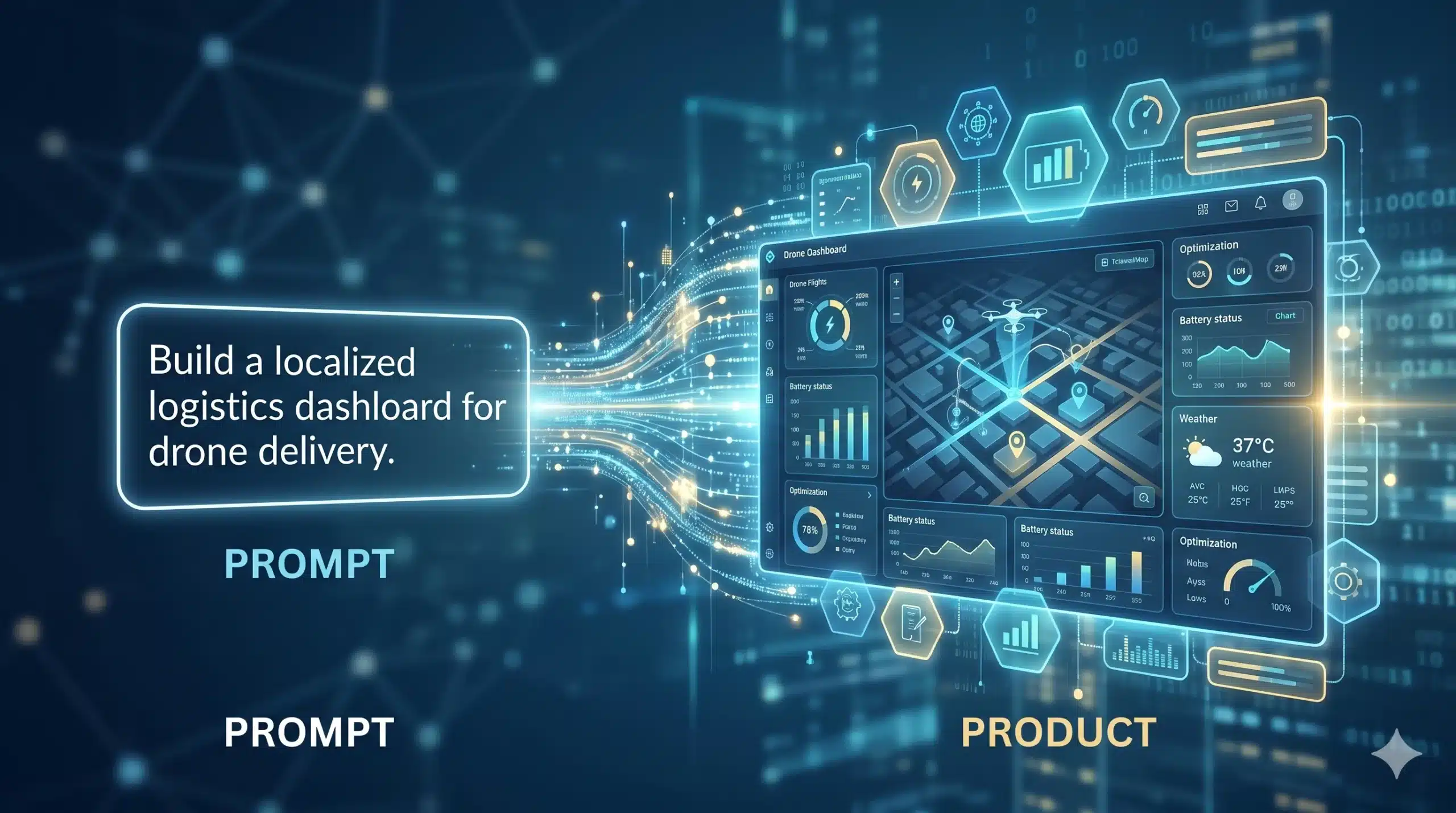
The traditional software development lifecycle is dying a slow, expensive death. For decades, the process has been a grueling marathon of manual requirements gathering, static wireframing, and thousands of hours of hand-cranked code. It is a world where a simple feature request can take six months to reach production. In an era where market demands shift in days, this “industrial age” approach to digital creation has become the ultimate growth inhibitor.
We are entering the age of AI-Native Software Design. This isn’t just about developers using AI assistants to write snippets of JavaScript; it is a fundamental re-imagining of how software is conceived and birthed. We are moving toward a reality where the “prompt” is the specification, and the “product” is generated, deployed, and optimized in a near-instantaneous loop.
The Shift: Why “Code-First” is Becoming “Intent-First”
The economic shift driving this trend is the collapse of the barrier between “business logic” and “execution.” Historically, a founder with a brilliant idea needed a translator—a developer—to turn that idea into a functional product. This translation layer is where ROI often goes to die, lost in miscommunication and technical debt.
Technologically, the rise of Large Action Models (LAMs) and sophisticated multi-agent systems has allowed us to bypass the manual drafting phase. Companies are no longer building software to last a decade; they are building “disposable” or “hyper-adaptive” software designed to solve a specific problem right now. The shift is from infrastructure management to intent management. If the cost of generating a bespoke application drops to near zero, the very definition of a “software company” changes overnight.
Technical Breakdown: The AI-Native Stack
AI-native design replaces the linear assembly line with a generative ecosystem. It relies on a stack that treats code as a fluid, rather than a solid.
- Neural Blueprints: Instead of static Figma files, designers use high-fidelity prompts to generate “living mockups” that possess underlying logic from day one.
- Agentic Orchestration: A “Manager Agent” decomposes a high-level prompt into database schemas, API routes, and frontend components, assigning these tasks to specialized “Worker Agents.”
- Just-in-Time (JIT) Compilation: Software is increasingly generated at the moment of need. If a user requires a specific data visualization that doesn’t exist, the AI-native system writes and renders the code for that module on the fly.
- Automated Integration: The system handles its own integration logic, automatically connecting to existing enterprise tools and ensuring that the new “product” plays nice with the legacy infrastructure.
The Generative Evolution
| Feature | Legacy Software Design | AI-Native Design (2026+) |
| Development Cycle | Months of sprints | Minutes of generation |
| Primary Input | Technical Specifications | Natural Language Intent |
| Scalability | Limited by headcount | Limited by compute credits |
| Maintenance | Manual patches | Self-evolving updates |
Real-World Impact: Hyper-Personalized Enterprise
The most profound impact of AI-native design is the death of “one-size-fits-all” SaaS. Consider a Digital Entrepreneur managing a portfolio of niche websites. Instead of trying to bend a generic Project Management tool to their will, they prompt a custom dashboard into existence: “Build me a tracker that syncs my AdX revenue, MozStriker logs, and Suzuki inventory, with a 9:16 vertical mobile view for my field team.” The software is generated specifically for their workflow, offering a level of efficiency no off-the-shelf product could match.
In the Healthcare sector, hospital administrators can generate internal triage applications that adapt in real-time to current patient loads and staffing shortages. These aren’t “features” added to a platform; they are entire, temporary micro-products generated to solve a crisis in real-time. This level of scalability allows organizations to be as agile as the startups that used to threaten them.
Challenges & Ethics: The Quality and Cost Paradox
While the speed is intoxicating, AI-native design introduces a new set of “integration” headaches and ethical minefields.
- The “Black Box” Problem: If an AI generates 10,000 lines of code in seconds, who is auditing it for security backdoors or logical fallacies? The “Reviewer” becomes the new bottleneck.
- Inference Economics: The compute power required to constantly generate and regenerate software is immense. For many, the ROI could be swallowed by the skyrocketing cost of high-end GPU clusters.
- Ownership & Copyright: When a product is 99% AI-generated, the legal definitions of intellectual property become blurred. Does the “prompter” own the code, or does the model provider have a claim?
The 5-Year Outlook: The Democratization of Creation
By 2030, the “Software Developer” title will likely split into two: the “Model Scientist” who builds the engines of generation, and the “Product Architect” who directs them. The act of “coding” will be viewed much like the act of “typesetting” is today—a niche, artisanal skill that is largely automated for the masses.